Showing posts with label stop snitching. Show all posts

Friday, December 21, 2007

Stop Snitching II and Schengen II

Two dyed-in-the-wool causes are celebrating the inception of Round II. While one of these involves witness intimidation, a murder rate in Baltimore that just topped 300 thus far in 2007, and kids with big guns, the other celebrates expansion of the pan-Euro safety zone and the solidification of a unified European continent.

<(courtesy of BBC)

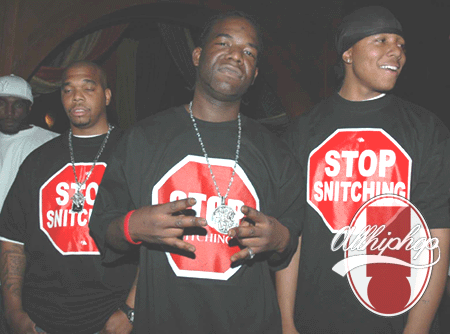
Stop Snitching in its 2nd avatar is now bigger and badder. The subject matter remains the same, but the stakes have climbed higher, since the original's makers mostly went to jail for crimes related to what they discussed openly in the ghettocumentary. This time around, the Baltimore Police Department ain't even playing no games.

Due to the cultural fallout from the first Stop Snitching, the 5-0 in Baltimore have no intention of ceding any ground to the thugs and/or film-makers, whom most mainstream Baltimorons groups together with the actual criminals, a mistake which may or may not be merely a strategic decision aimed at simplifying the equation.

The unbearable truth for many law-abiding citizens is that there is a culture of cool surrounding the culture of actual thuggery. While there is a diehard core of dealers, sellers, and support staff who actually engage in the urban pharmaceutical business, there is a much larger group of citizens who revere the cultural aura surrounding Stop Snitching but do not actually adhere to its titular mantra.

As such, the terrain has become rockier for the fans and the foes. While I have not yet purchased the new dvd, which is on sale for 14.95 on select websites, it appears that production values are a bit more high-octane this time around. Judging by the silvery Mac with which the director gracefully toys in the clip above, I would say that the sequel probably outdoes the original in cosmopolitanism, finesse, and perhaps even rawness. "Like Part 1 on steroids," this realer than reality tv material is a much more potent cultural statement than most people understand. Part 2 appears more intellectual and nuanced than the silly original. Or perhaps not everyone agrees that showing footage of kids toting guns and puffing Js is not sophisticated or novel. The director claims he is just holding a mirror up to society. And, for all we know, maybe he does indeed provide an accurate depiction of the double-edged sword that thugs and police loathe and love: snitching!

If the movie does a satisfactory job of defining snitching, then it might end up defending the cause of snitch prevention. In the first film, Skinny Suge made a concerted effort to talk about the extent of his snitch prevention movement and how he intended to start a foundation to oppose this insidious form of anti-criminal criminality. He swore to exact vengeance on those criminals who used the system as long as they could profit from it, and then turned against that same system once they opportunistically realized a new avenue of snitchery might better suit their tastes. I'm curious whether or not the new ghettocumentary lives up to expectations. I also am uncertain about whether the film will further marginalize the Stop Snitching movement or whether both sides in this cultural battle will become more entrenched to the extent that Stop Snitching becomes immortalized as not just one part of the holistic ghetto philosophy but as the cardinal rule.

Schengen II, on the other hand, celebrates progress, order, and continuity, rather than devolution, chaos, and uncertainty. The new concept of Europe that is embodied by the increasingly porous set of nation-states that comprise the continent continues to define itself in unprecedented ways. While much of the rest of the world is erecting concrete slabs and uber high-tech barriers to border-crossing, Europe has been chugging along on this path to cohesion, cooperation, and convergence. While Europe has its problems (high unemployment, ethnic tensions, and swollen welfare coffers), the European course of development leaves the U.S. (Jah bless) in the dust in certain key areas. Perhaps I am just bitter about my country's lack of agreement on environmental and healthcare issues. Maybe I have a naive view of contemporary security imperatives and the often jingoistic tone of American foreign policy, but we are seeing the results of ill-advised policies. The rapidly falling dollar perhaps best demonstrates the current President's various ingenious activities, and expats are more keenly aware of how foreign policy decisions impact the American relationship with the rest of the world in both the financial and cultural domains.

While I don't want to sound like Michael Moore by praising an undoubtedly positive feature of European life and speaking ill of American phenomena (oh how I love apple pie with American cheese melted on top!), I cannot cease comparing my homeland to our buddies across the Atlantic. The EU is incredible in its ability to solidify this notion of European-ness. Although the folks in Brussels need to work out lots of Constitutional issues, immigration laws, and final borders, this supra-national entity is unbelievable. I shall not express too fawning of an attitude towards the EU, but I sure do admire its level of geopolitical achievement. One may now walk/drive/bike across Europe from Estonia to Portugal without being stopped at any borders or being checked for a passport. The pace at which Europe has become integrated continues to amaze. One day, perhaps the Arabic Gulf Union, South American Union, and a few other supra-national unions might accomplish the same things, but for now, Schengen II is superfly!

Tuesday, December 12, 2006

Wire on Tap

Drugs get transacted. Buyers and sellers develop an extensive system of exchanging product for capital. The industry thrives, while the city ails. Addicts, runners, snitches, and bystanders get stomped by industry head honchos, who patrol the streets of the ghetto with full impunity. Their eyes are lit up with the knowledge that their code of behavior is more robust than the official rule of law. Cops attempt to rollback the prevailing urban pharmaceutical system of distrubution with the courts, zero tolerance, aggressive enforcement tactics. But to no avail. This is the world inhabited by the Wire, HBO's stellar program that just concluded its fourth season.

Authenticity is the province of this show, as its writer and director were born and bred on Baltimore's police, journalism, and urban mayhem. There is substantial reason to believe that the show expertly captures the gritty reality of a vast segment of Baltimorean cultural and economic life. The dealers are case studies in diehard entrepreneurialism, their egos stroked by a city whose fiends soak up a constant supply of chemical sustenance. The drug kingpins in the Wire are depicted as masters of their domain who generally are inclined to knock off relatively undeserving interlopers. Stringer, the Barksdales, and Omar consist of the business elite in the show's capitalizing upper echelons. Their drive to accumulate wealth is egged on by the mouths of the hungry and hopeless habitual drug users, who number around 50,000 in today's Baltimore.

That's in a city of about 640,000 folks. A city on the population rebound from it's lowpoint in 2000. An urban unit that suffers from the highest per capita murder rate of any American city with a population over 250,000. Averaging between 250 and 300 murders yearly, Baltimore's murder rate remains stagnant at about 6 times New York's. Believe it or not, Baltimore was the largest American city after NYC until 1870.

In this context, the Wire portrays B-more as a city on the edge. Though so far I've not watched past the first season, the show depicts my hometown as a battlefield. The cops try desperately to pursue justice the best ways they know how, without trampling on too many civil liberties but also without full respect for the rights of the criminals. Clearly, in the Machiavellian world of the drug trade, the cops can't be too bothered by the letter of the law. Clearly, the dealers aren't bound by anything more than a primitive Stop Snitching ethic that supposedly governs their actions - until they too face the Prisoner's Dilemma head on and must rat to save their own skin.

Is the show excessively negative in its depiction of a criminal culture that seems to overshadow the more promising aspects of city life? What does the show owe the city in terms of positive reinforcement of viable role models or upright citizens? The show does not delude viewers into thinking that the drug trade is all gravy. And neither does it suggest that police work is sacred. To the contrary, no one truly ends up on top in the Sisyphean challenge of preserving a semblance of urban order. Cops need to cooperate with the dealers to whom they have access. The way they pit certain players against others that get played reiterates the idea that anyone is liable to "get got" at almost any time. The brutish tendencies of both sides in the drug war belie the best intentions of certain cops to earn an honest living and of the few dealers that seek to minimize the collateral damage of their daily peddling and gun-toting.

The Wire treats enterntainment as a profane pursuit. Whereas some cop shows profess to contain sacrosanct messages about public policy or social redemption, this particular one steers clear of moralizing. The nightly reality of Baltimore's thug culture is straight fucked up. There's no denying the deadly characteristics of a street game that, while increasing the inner city GDP by a significant multiple, renders decrepit vast expanses of the city and creates an entrenched cycle of violent engagement between urban security forces, opposing drug gangs, and the dreaded snitches that bridge the gap in this civil war of sorts. Government soldiers cannot be entrusted with the authority to enforce laws on an equal basis. Gangsters produce an endearing culture of criminal glorification with regards to the urban other. Historically accurate fiction gives us the impression that we are privy to these social universes that are far removed from our own. The Wire has got me on tap.

Tuesday, October 24, 2006

YouTube B-More Club Videos

On this post, I will ignore my usual rules about posting solely my own creations. In search of elevated B-More Club dance skillz, I scoured YouTube for the best and brightest of Baltimore's dance brigade. I'll see yall at the Mo's Tunnel (that's the name I've given to the fantasyland B-More Club that we'll be establishing to recover the old glory of B-More Club's Golden Age. Enjoy the videos!

Quintessential Rockin Off


Stop Snitching and Start Dancing


Crackheads and Winos in Northwest B-More Git Up


East Baltimore Got the Club Face

Wednesday, December 14, 2005

Stop Snitchin


Ok, I think by now everyone is familiar with the Stop Snitching enterprise. I jumped on the Stop Snitching bandwagon last spring, with a purchase of the DVD on the internets. For months, I basked in the glory of the street motto, throwing around the hoodrat banter because it's catchy and rebellious. To revel in the popularity of Stop Snitching is to identify with the "street" - a lifestyle, mindset, and society that exists outside the bounds of white-dominated, middle-class, standard law and order civilization. Hip-hop derives its credibility from its subversive ability to mock a set of bland bourgeois values in favor of a flashy, rhythmic, and unruly culture.

However, it is a mistake to suggest that the Stop Snitching creed typifies all of hip-hop culture. This creed is undoubtedly highly pervasive in a large segment of the population that identifies with hip-hop. Yet, at some point, the line between foul, gangland violence and stylized urban garb becomes blurry. Does donning the Stop Snitching uniform imply that one embraces witness intimidation at its ugliest?

Currently, three Bloods are standing trial in Baltimore for firebombing a snitch's house. This sinful snitch happens to be the Harwood Community Association President, Edna McAbier. After years of watching thugs take over her neighborhood, McAbier began contacting the police more and more. Because she threatened the turf and thus profits of neighborhood dealers, Snitch McAbier got Molotovs launched at her crib. Does the Stop Snitching credo truly intend to silence innocent civilians on the sidelines of the drug war? Or ought it apply only to those who are part of the game?

It seems to me that some mafias respect their community fabric to the extent that no elderly lady would ever need to rat them out. However, so much gang violence in American cities has reached the point where ferocious kingpins or even minor wankstas feel menaced by geriatric neighborhood residents. Where's the justice? Stop snitching, both in video and t-shirt formats, is filled with humor and cultural nuance. However, the witness intimidation problem has become too severe to condone the whole phenom. On the one hand, I seek to extol the virtues of a rebellious subculture. On the other, I realize that too many people suffer unnecessarily when thugs tip the scales of justice in their favor.

This is not to say that I wholly empathize with urban law enforcement. I am adamantly opposed to the drug war for so many reasons. I think the so-called war on drugs is misguided, ridiculous, and inappropriate. So, perhaps law enforcement has pushed drug dealers to resort to such vile tactics. The police, in many instances, are equally a band of street thugs. I resent the tactics of both the legally-sanctioned enforcers and the illegal street soldiers. Neither side is willing to step down at this point. And, consequently, we all lose! Innocent lives are lost in the hood due to gun clapping and all manner of street antics. The civil liberties of young men are compromised across the country because law enforcement seeks to weed out the gangstas among us. Drug addicts are prevented from attaining optimal health because we have criminalized their medical problems. Law enforcement funds and other public resources are squandered on an endless battle to up the violence ante and to shower us with government propaganda.

The time has come to halt both the government gangs and the street gangs, for both are complicit in an undying war. With steady demand for hard drugs, the supply will always be available from somewhere. Regardless of how many open-air drug markets are shut down or how many drug dealers are locked up, the scourge of drug addiction will remain. The link between violent crime and psychological/medical deviance must be severed. Addiction is a medical problem, and violent crime is only necessary because dealers seek to protect their territory.

George W. Bush, come out of your rock house and tell your federal boys to start selling rock on the block. Put the dealers out of business by undercutting them - with your treatment centers dotting every major city in the country. Too many people have a vested interest in this game. Too many people have too much pride to snitch and too much idiocy to change.

I'm not sure what percentage of urban GDP is illicit drug sales. The jobs provided by this industry are indeed sought after. Profits can be enormous, but death or incarceration is virtually certain. Talented young men are lost to the drug trade when they could be excelling in other more healthy pursuits. Resources should be poured into shifting dealers into legitimate employment. In any event, jails are a short-term solution for a society that has no regard for long-term consequences. Jails provide us with tougher and tougher thugs.

Law enforcement needs to put down its big guns, too. The whole law enforcement industry (corrections, local police, DEA, FBI) has a vested interest in maintaining the current level of funding and support for the drug war. Many in this community derive profit from this sinister process. The pigs need to cooperate with the dealers and save the lives of innocent bystanders. And, the dealers cannot enforce the Stop Snitching code on those who remain outside the game, who have not agreed to abide by the street contract. Either way, drugs will eventually be taken out of the street game and pushed by medical staff in scrubs. And, I suppose, the thugs in their long white tees will ultimately find other poisons to push, once this urban pharmaceutical hustle dries up.
 
Google
Locations of visitors to this page Locations of visitors to this page Locations of visitors to this page Locations of visitors to this page