Showing posts with label baltimore. Show all posts

Friday, December 21, 2007

Stop Snitching II and Schengen II

Two dyed-in-the-wool causes are celebrating the inception of Round II. While one of these involves witness intimidation, a murder rate in Baltimore that just topped 300 thus far in 2007, and kids with big guns, the other celebrates expansion of the pan-Euro safety zone and the solidification of a unified European continent.

<(courtesy of BBC)

Stop Snitching in its 2nd avatar is now bigger and badder. The subject matter remains the same, but the stakes have climbed higher, since the original's makers mostly went to jail for crimes related to what they discussed openly in the ghettocumentary. This time around, the Baltimore Police Department ain't even playing no games.

Due to the cultural fallout from the first Stop Snitching, the 5-0 in Baltimore have no intention of ceding any ground to the thugs and/or film-makers, whom most mainstream Baltimorons groups together with the actual criminals, a mistake which may or may not be merely a strategic decision aimed at simplifying the equation.

The unbearable truth for many law-abiding citizens is that there is a culture of cool surrounding the culture of actual thuggery. While there is a diehard core of dealers, sellers, and support staff who actually engage in the urban pharmaceutical business, there is a much larger group of citizens who revere the cultural aura surrounding Stop Snitching but do not actually adhere to its titular mantra.

As such, the terrain has become rockier for the fans and the foes. While I have not yet purchased the new dvd, which is on sale for 14.95 on select websites, it appears that production values are a bit more high-octane this time around. Judging by the silvery Mac with which the director gracefully toys in the clip above, I would say that the sequel probably outdoes the original in cosmopolitanism, finesse, and perhaps even rawness. "Like Part 1 on steroids," this realer than reality tv material is a much more potent cultural statement than most people understand. Part 2 appears more intellectual and nuanced than the silly original. Or perhaps not everyone agrees that showing footage of kids toting guns and puffing Js is not sophisticated or novel. The director claims he is just holding a mirror up to society. And, for all we know, maybe he does indeed provide an accurate depiction of the double-edged sword that thugs and police loathe and love: snitching!

If the movie does a satisfactory job of defining snitching, then it might end up defending the cause of snitch prevention. In the first film, Skinny Suge made a concerted effort to talk about the extent of his snitch prevention movement and how he intended to start a foundation to oppose this insidious form of anti-criminal criminality. He swore to exact vengeance on those criminals who used the system as long as they could profit from it, and then turned against that same system once they opportunistically realized a new avenue of snitchery might better suit their tastes. I'm curious whether or not the new ghettocumentary lives up to expectations. I also am uncertain about whether the film will further marginalize the Stop Snitching movement or whether both sides in this cultural battle will become more entrenched to the extent that Stop Snitching becomes immortalized as not just one part of the holistic ghetto philosophy but as the cardinal rule.

Schengen II, on the other hand, celebrates progress, order, and continuity, rather than devolution, chaos, and uncertainty. The new concept of Europe that is embodied by the increasingly porous set of nation-states that comprise the continent continues to define itself in unprecedented ways. While much of the rest of the world is erecting concrete slabs and uber high-tech barriers to border-crossing, Europe has been chugging along on this path to cohesion, cooperation, and convergence. While Europe has its problems (high unemployment, ethnic tensions, and swollen welfare coffers), the European course of development leaves the U.S. (Jah bless) in the dust in certain key areas. Perhaps I am just bitter about my country's lack of agreement on environmental and healthcare issues. Maybe I have a naive view of contemporary security imperatives and the often jingoistic tone of American foreign policy, but we are seeing the results of ill-advised policies. The rapidly falling dollar perhaps best demonstrates the current President's various ingenious activities, and expats are more keenly aware of how foreign policy decisions impact the American relationship with the rest of the world in both the financial and cultural domains.

While I don't want to sound like Michael Moore by praising an undoubtedly positive feature of European life and speaking ill of American phenomena (oh how I love apple pie with American cheese melted on top!), I cannot cease comparing my homeland to our buddies across the Atlantic. The EU is incredible in its ability to solidify this notion of European-ness. Although the folks in Brussels need to work out lots of Constitutional issues, immigration laws, and final borders, this supra-national entity is unbelievable. I shall not express too fawning of an attitude towards the EU, but I sure do admire its level of geopolitical achievement. One may now walk/drive/bike across Europe from Estonia to Portugal without being stopped at any borders or being checked for a passport. The pace at which Europe has become integrated continues to amaze. One day, perhaps the Arabic Gulf Union, South American Union, and a few other supra-national unions might accomplish the same things, but for now, Schengen II is superfly!

Saturday, December 01, 2007

Crank Dat Soulja Boy (B-Club Remix)


For all y'all soulja slims, whodisans, bamas, b-more club heads, and 215 jawns, here is your b-more club fix. Though I presently be rather far from the epicenter of the b-more club universe, we can all build mega-mecca-monuments to the gods of thine sacred bawlemer anthems...

Tuesday, January 09, 2007

Katrina's Supremely Eminent Domain

There seem to be a few irrefutable truths that emerge from the Gulf Coast's experiences with the cataclysmic 2005 hurricane season. The most drastic shift in the societal balance of the New Orleans metropolitan region derives from the impossibility of resuming the erstwhile pattern of residential settlement. Given the utter destruction of areas such as the Lower Ninth Ward and the Route 23 corridor down south into the deepest reaches of the boggish Cajun-flavored bayou, it's become clearer that governmental authorities need to step in to prevent building in areas where further human habitation would be too costly. Such a prohibitive cost precludes the cultural or social contribution that continued community presence would offer to the region. At some point, the economic and practical pricetag of shoring up marshlands that have been degraded reaches the point of no return. The levee system has always been minimally comprehensive. It's just that a fully responsible government would insall a levee network that is far more foolproof and impregnable. The flood protection that existed pre-Katrina was no match for a beastly storm, and there's no reason to believe that local, state, or federal government will ever cough up enough funds to construct a system that would protect neighborhoods - whether wealthy or poor, black or white.

Controversies over land use reflect general patterns of sociological conflict between classes who have divergent ideas about how best to organize communities productively. In contemporary American society, there seem to be two opposite phenoms that characterize neighborhood change: gentrification and ghettoization. The first connotes increase in property value, decreasing crime rates, and domestication of chaotic neighborhood elements. The second suggests a decrease in property values, increasing crime rates, and the decline in neighborhood orderliness, generally associated in American cities with the influx of minority or immigrant groups. These contrasting movements are occurring simultaneously in America in different parts of every single city. While some neighborhoods are "going downhill" and "turning bad," yet others are "getting fixed up" or "developed." It seems like people sometimes perceive that cities are either proceeding in one way or the other. This is not the case. There is simultaneous movement in both directions. Certain neighborhoods are being vacated at alarming rates and are doomed to years of dilapidation and not-so-benign-neglect, leading to a state of under-development or regression. At the same time, many other neighborhoods in the same city may face rapid evolution.
These assumptions about "getting better" or "getting worse" exist aside a league of other variables that measure the health of cities, including educational opportunities, job availability, green space, and transportation efficiency. There are thus multiple ways of measuring the constantly evolving truths of urban life. No subjective evaluation is possible for urban fabrics in which competing classes and institutions vie for resources, and each demographic segment is not even wholly classifiable as benefitting from certain patterns of development.

New Orleans and Baltimore are the two primary cases that I'm envisioning as I explore the ramifications of urban geographic shifts. New Orleans, for one, was characterized by the severe indigence and urban blight of many predominantly African-American communities. While it is indeed presumptuous of me, as an outsider, to apply my scholarly understanding of urban change to concrete realities of habitation and development, I nonetheless am in a position to evaluate incipient changes in standard of living and quality of community interaction. The problem, which I do not pretend to be able to solve, hinges upon what most people would consider the worst neighborhoods of these two urban polities. The two examples are the Lower Ninth Ward in New Orleans and the MidEast section of Baltimore. While the conditions of renewal, population transfer, and so-called progress are different in both cases, there are similar fears and aspirations emerging from the clashing camps. The pro-renewal folks cite the ameliorated land use, public good, and progress. Those opposing the gentrification talk about the government-sanctioned destruction of a robust community, inadequate compensation for property owners, and the lamentable transfer of land to more powerfual socioeconomic agents.

While the New Orleans example does not involve the explicit use of eminent domain, the same justifications and methods are employed as in the legally sanctioned imposition of land use statutes. In the MidEast section of Baltimore, Johns Hopkins Hospital has convinced Baltimore City's quasi-governmental economic arm (the Baltimore Development Corporation) to incur the powers of eminent domain in commandeering 10 square blocks of raw ghetto and mostly abandoned blocks of rowhouses for use by nascent biotech research interests. Following the logic of the Supreme Court's ruling about the use of eminent domain in New London, CT, a host of American cities instantly applied this principle to their crusade to seize blocs of subaltern communtities for use by more powerful interests. Again, these processes occur simultaneously to stable, middle-class neighborhood "seizure" by lower class groups. Perhaps there is some metric that demonstrates the overall rate of progress in a city and suggests which way a city is moving in an ostensibly zero-sum development game. Is it ultimately productive, whatever that adjective entails, to destroy the most depressed neighborhoods in order to fulfill broader social goals? Some might argue that sense of community is the only thing that these neighborhoods still possess and that therefore it is not advisable to strip folks of their pride and communal sensibilities. On the other hand, why preserve ghettos that are some of the most perilous and scarred zones in America, for residents and passers-by alike?

Is there an objective arrow of development that captures the transformation of urban space? I don't believe that there is a generalized, simplistic, and objective evaluation of progress, when such an equation would aim to grasp an array of postmodern factors that involve multiple subjectivites and divergent intrepretations of value and public good. Yet, a few eternal political truths remain, as far as I'm concerend. The "less desirable" groups who are displaced by EmDo and gentrification deserve decent housing conditions. This can be achieved by illiberal policies that transcend the market's ability to optimize neighborhood arrangements. The free market usually does not provide profitable opportunities for betterment of heavily minority districts within racially and socioeconomically stratified cities.

Lastly, there are normative questions that attempt to address who exactly ought to live in certain places. Should decisions about residential location and community displacement be made by means of the general will, by nominally democratically-elected councils, or by capitalist elites? Who bears the right to occupy land, either in America or beyond. Psychological attachment to land is indeed a complex phenomenon that involves psychogeographic considerations that delve deep into history and multifaceted community relations. Consideration of public good as it relates to eminent domain must include concurrent articulation of the opposite and simultaneous social processes. This means that we all must realize that "there goes the neighborhood" is a reality for folks at both ends of the spectrum. It is not merely the downtrodden or merely the wealthy who triumph in the perennial exchange of land and population across the urban landscape.

Tuesday, December 12, 2006

Wire on Tap

Drugs get transacted. Buyers and sellers develop an extensive system of exchanging product for capital. The industry thrives, while the city ails. Addicts, runners, snitches, and bystanders get stomped by industry head honchos, who patrol the streets of the ghetto with full impunity. Their eyes are lit up with the knowledge that their code of behavior is more robust than the official rule of law. Cops attempt to rollback the prevailing urban pharmaceutical system of distrubution with the courts, zero tolerance, aggressive enforcement tactics. But to no avail. This is the world inhabited by the Wire, HBO's stellar program that just concluded its fourth season.

Authenticity is the province of this show, as its writer and director were born and bred on Baltimore's police, journalism, and urban mayhem. There is substantial reason to believe that the show expertly captures the gritty reality of a vast segment of Baltimorean cultural and economic life. The dealers are case studies in diehard entrepreneurialism, their egos stroked by a city whose fiends soak up a constant supply of chemical sustenance. The drug kingpins in the Wire are depicted as masters of their domain who generally are inclined to knock off relatively undeserving interlopers. Stringer, the Barksdales, and Omar consist of the business elite in the show's capitalizing upper echelons. Their drive to accumulate wealth is egged on by the mouths of the hungry and hopeless habitual drug users, who number around 50,000 in today's Baltimore.

That's in a city of about 640,000 folks. A city on the population rebound from it's lowpoint in 2000. An urban unit that suffers from the highest per capita murder rate of any American city with a population over 250,000. Averaging between 250 and 300 murders yearly, Baltimore's murder rate remains stagnant at about 6 times New York's. Believe it or not, Baltimore was the largest American city after NYC until 1870.

In this context, the Wire portrays B-more as a city on the edge. Though so far I've not watched past the first season, the show depicts my hometown as a battlefield. The cops try desperately to pursue justice the best ways they know how, without trampling on too many civil liberties but also without full respect for the rights of the criminals. Clearly, in the Machiavellian world of the drug trade, the cops can't be too bothered by the letter of the law. Clearly, the dealers aren't bound by anything more than a primitive Stop Snitching ethic that supposedly governs their actions - until they too face the Prisoner's Dilemma head on and must rat to save their own skin.

Is the show excessively negative in its depiction of a criminal culture that seems to overshadow the more promising aspects of city life? What does the show owe the city in terms of positive reinforcement of viable role models or upright citizens? The show does not delude viewers into thinking that the drug trade is all gravy. And neither does it suggest that police work is sacred. To the contrary, no one truly ends up on top in the Sisyphean challenge of preserving a semblance of urban order. Cops need to cooperate with the dealers to whom they have access. The way they pit certain players against others that get played reiterates the idea that anyone is liable to "get got" at almost any time. The brutish tendencies of both sides in the drug war belie the best intentions of certain cops to earn an honest living and of the few dealers that seek to minimize the collateral damage of their daily peddling and gun-toting.

The Wire treats enterntainment as a profane pursuit. Whereas some cop shows profess to contain sacrosanct messages about public policy or social redemption, this particular one steers clear of moralizing. The nightly reality of Baltimore's thug culture is straight fucked up. There's no denying the deadly characteristics of a street game that, while increasing the inner city GDP by a significant multiple, renders decrepit vast expanses of the city and creates an entrenched cycle of violent engagement between urban security forces, opposing drug gangs, and the dreaded snitches that bridge the gap in this civil war of sorts. Government soldiers cannot be entrusted with the authority to enforce laws on an equal basis. Gangsters produce an endearing culture of criminal glorification with regards to the urban other. Historically accurate fiction gives us the impression that we are privy to these social universes that are far removed from our own. The Wire has got me on tap.

Wednesday, November 29, 2006

Hamsters, Bodymore, and Bawlmerese

There are so many parochial facets of Baltimore that make this city's natives proud to call (c)Harm City home. The "o" in home is a long sort of "o," and there's a bit of a Hiberno-English or perhaps Cornish Enligh twang on the phoneme. All of you who are familiar with the highly particular "o" sounded in these parts will know of what I am speaking. While the accent and dialect of English spoken in Baltimore is similar to that spoken in and around Philadelphia, south Jersey, and up and down Delaware, the distinctly Baltimore accent is by far the most fascinating sort of mid-Atlantic English. Hyperbolic I am not, and you shall take a most pleasant trip to Highlandtown or Hampden to find out from where the mystique doth come.

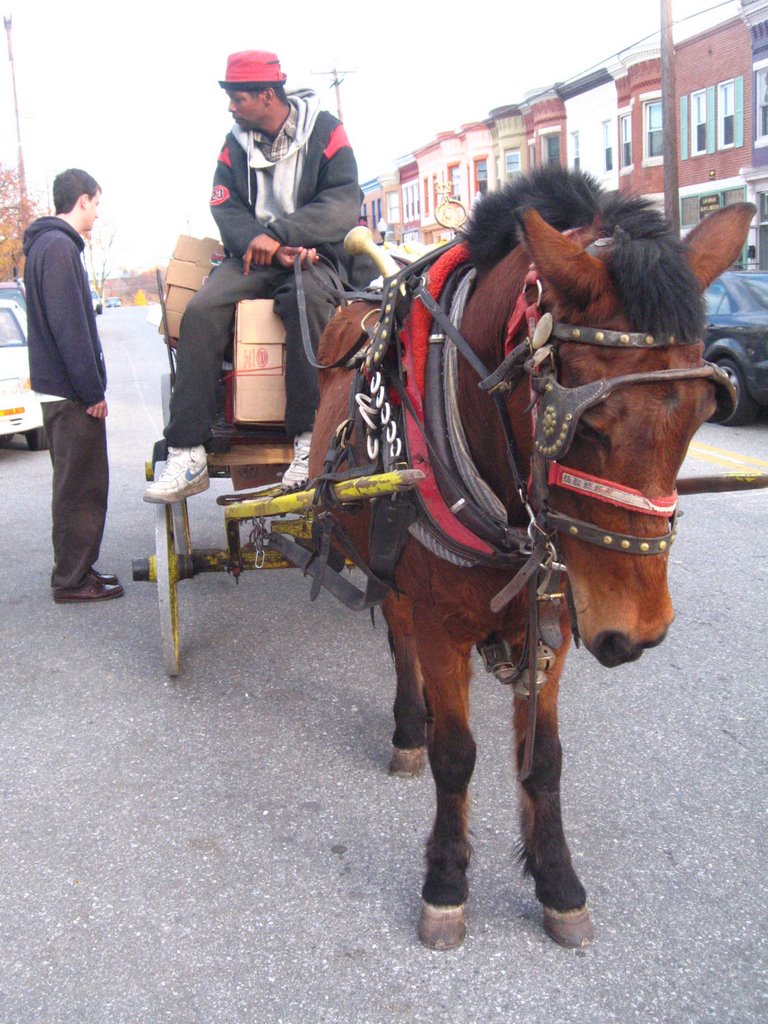
In particular, the hamsters (Hampden hipsters) became enthralled so much by the accent most commonly found in Hampden that they began to flock to the neighborhood formerly inhabited exclusively by mill workers and other industrially-inclined folk whose ancestors migrated there from Appalachia. Though the neighborhood was in serious decline throughout the 80's and 90's, the urban locale is now one of the hottest areas in B-more. The main commercial artery of Hampden is known as the Avenue (36th st.), where a mix of true Hampdenites, hamsters, and assorted other Baltimorons roam the strip. Kitsch, schmaltz, and authentic indigenous crafts dot the landscape, but an uneasy feeling of invasion pervades. Is the old Baltimore reluctant to step aside, or can the two demographic segments coexist harmoniously? A-rabbers still parade their donkeys across the Avenue, peddling their produce to pedestrians while parroting paeans. And, Hampden plays host to a breed of urban dweller that is said to have missed the second half of the 20th Century.
The rudiments of Baltimore's unique flava are found in horrible haircuts, mispronounced consonants, and in the remarkably parochial citizenry who typically cannot name more than three neighborhoods outside of the one they inhabit. These attributes are beautiful, and don't let anyone tell you otherwise. Gentrificious, educated, and stodgy folks might lend human capital to their geographic niches, but the masses provide cities with a sense of tradition, a love of things that aren't so peachy, like stubborn murder rates and b-more club. However, don't let this laundry list convince you that Baltimore hasn't been well-served by its honorable mayor. Also, don't be deceived into thinking that I don't adore my native city (though I do in fact currently reside in the northwestern portion of the metropolitan region and not in the inner sector).

Lord O'Malley has indeed created a city that is more amenable for absorbing yuppies. Though this town ought not truthfully proclaim (as it does on omnipresent bus stop benches) that it's the Greatest City in America, this town has a lot going for it. One native, Spankrock, once said that Baltimore is the most under-rated party city in America. A budding anthropologist from Manhattan's Upper West Side once became so obsessed with both Dundalk and Hampden that he decided to excise his uptown Yankee demons and become baptized as a born again Baltimoron.

We got crabs, Berger cookies, and damn good police dramas abour our urban pharmaceutical industry. Stop Snitching, Babe Ruth, and Edgar Allan Poe all germinated in Baltimore. Long live Mr. Boh! How bout dem Ravens?

Me, I'm just impatiently waiting on the construction of two new mass transit lines: one, the Green, will be an extension to the NorthEast of the current Subway line that ends at Johns Hopkins Hospital; two, the Red, will run east-west from the Social Security Administration to Patterson Park, through downtown. These projects likely won't be completed til 2014 or so. We've got 1/3score to wait until Baltimore has a genuine public transit network. Citistat/Compstat may be able to pinpoint the locations of lead poisonings, waste removal, and property crimes, but it cannot provide sufficient impetus for an end to the tremendous favortism that city, state, and federal governments have exhibited for cars, highways, and sprawl. Enough is enough. Baltimore is back. JHU might be commandeering the Middle East community, but B-more is on the map now more than ever. After New York City, Baltimore was the 2nd city in the US to reach a population of 100,000. In fact, until 1870, Baltimore was indeed the 2nd most populous city in the nation. Rod Lee, show these knuckleheads what time it is!

Tuesday, October 24, 2006

YouTube B-More Club Videos

On this post, I will ignore my usual rules about posting solely my own creations. In search of elevated B-More Club dance skillz, I scoured YouTube for the best and brightest of Baltimore's dance brigade. I'll see yall at the Mo's Tunnel (that's the name I've given to the fantasyland B-More Club that we'll be establishing to recover the old glory of B-More Club's Golden Age. Enjoy the videos!

Quintessential Rockin Off


Stop Snitching and Start Dancing


Crackheads and Winos in Northwest B-More Git Up


East Baltimore Got the Club Face

Monday, December 19, 2005

Hood House Holdings, LLP

If y'all didn't already know, Gabe Nelson and I are highly interested in undertaking a business venture called Hood House Holdings, which would invest in a blighted block somewhere deep in the hood. Our goal is first to identify a place so immersed in blight that other real estate sharks have not beat us to the punch. It's very important to get a good value on a purchase. Thus, we would like to avoid locations where demand for hood houses is already elevated. In addition to having deep hood status, it would be optimal for the location to be near somewhat commerical amenities and also in proximity to some sort of green space.

Second, upon identifying our block of interest, the next task is project financing. We intend to keep the city abreast of our plans, but we are not certain if we could cut a deal with the city for a whole block of abandoned, city-owned property. Either way, we would be shopping around to banks for a competitive loan for our Hood House Holdings venture. It's a shame that interest rates have gone up several percentage points on commerical loans in the past two years. It's not quite as cheap these days as it was when interest rates bottomed out. Regardless, other sharks face the same market pressures, as the money supply is tightened and less projects in general seek financing.

Third, after ascertaining a solid plan for financing this venture, the perfect opportunity would arise to design a block-long hood house with amenities never before seen in an American hood. Upon assembling a team of certified Hopkins engineers, the house would get severely tricked out. I suppose the security system would first need to be tweaked, since such a feature would prevent future loss of goods from the Hood House. The exterior of the dwelling would get tagged up by our team of graf artists, and we would commission the city's gayest landscape designers to spruce up the sidewalk and generally spruce up the Hood House. Internally, we would definitely require some rather serious renovations to the existing property. Hipsterites and like-minded folk would be promised a spot in the dwelling complex if they agreed to participate in the project.

Overall, the general concepts have been described for our plan to enter into a serious process of Hood renewal. We are interested in this mission to create an oasis of different culture in the otherwise-blighted Hood. Moreover, it'll be an affordable place to live and a solid real estate investment. In our process of detournement, we seek to extend the Situationist ideal to the hood. Spontaneous injection of postmodern attitudes and contrarian sensibilities into the Hood will be a way to address the outrageous separation that characterizes our divided society. We aim to counter the trend of gentrification with our brand of residential and commerical life, which not only respects Hood hospitality but actually integrates the finest aspects of Hood life into the fabric of our venture. We extol certain aspects/virtues of hood culture and seek to live on the fringe of bourgeois society, forming a link between the outcasts of the Hood and the card-carrying bourgeoisie.

Hood House Holdings is gettin' busy. Watch out now, we're bringing the whole crew in for Situationist instigation and exaltation.

Sunday, December 18, 2005

musical genius

Here are 3 musical geniuses who are blowing UP. Cop their shit, the block is hot, tell P we ready!

Scullin already registered a blogospheric comment about Spankrock yet I need to add that Naeem got soul. Just had a few vinyl tracks released on Big Dada, but look for the LP comin' soon.

J-Ro 3000 cooks up mean beats, and word on the street is that the man will be hittin' the studios again with pen, pad, and peroxide. This harmonic sleuth lays down tracks like Three 6 Mafia lays down the law-breaking.


Sir Anand Wilder likes his brew brothy and his broads, well, uhh, broad-minded. His folk-soul Coal Miner Musical is set to hit stores some time in December '07 if Anand ever comes back from the Motherland.

Saturday, December 17, 2005

Baltimore Club Music: Suburbs to the Tenement

Going to Mo's was like visiting a tenement party, sweaty, filthy, lewd as a LowerEastSide tenement project circa 1920. Mo's was the holy land. Mo's was our own private Garden of Eden, located northeast of White Marsh and its lovely avenue. It was everything and all things that we could ever have dreamt of.

A shrine to the sanctity of primeval enchantments, lasciviousness, and driving percussion that turn young human beings dancing machines. The music is of proletarian origins, that B-more Club sound. It dates back to "Doo Doo Brown" and "The Perculator" and has most recently derived most of its musical influences from motown and contemporary hip-hop tastes. The B-More Club DJs exhibit fervent devotion to the Supremes, the Marvalettes, and (Lil' Jon &) the East Side Boyz. Guys and girls grinding their gizmos together, all the while frollicking about to a throbbing backbeat and kick drums that propel your inner rhythm towards percussive paradise. . .

Mo's was an escape from the confines of day-to-day anti-Mo life. The concept of Mo's, was for us, something that allowed savage displays of pelvis-to-pelvis art. B-More club music was the enabler.

Here's an article I wrote for the Baltimore Sun when I did news reporting in Baltimore County over the summer of 2002. This was the summer of White Trash Anthem and lots of Mo's recollecting. My middle-aged, bland editors did not agree to publish my story on B-More Club. They were too square. The Sun did not actually end up reporting on B-More club for another 3 years, when two halfway decent articles by guys who had clearly never actually lived the B-More Club experience got on the cover of the Sunday Arts & Society section. August 21, 2005, was the first time that the Sun allowed B-More club tales to grace its pages - three years, two weeks, and one day after I initially submitted my B-More club story. The version below is the first version of the story that I pushed to my editors. I made considerable changes to the piece three days later, on August 9, 2002, but the final version disappeared in the vast Sun story database, never to be found again.

Hooray Hooray to B-more Club! I'm planning a 20th Anniversary bash for B-More Club to be held June 14th, 2007. It'll be magnificent circus of Mo's memories and funky number sixty-nines.

Anyway, here's the text of my feature on B-More Club. Good night from the suburbs. Good morning to the tenements.


Shawn Caesar nonchalantly picks up the phone at his cluttered desk to call DJ Spice, one of many DJs signed with Unruly Productions. Shawn informs the affable DJ about an upcoming soiree at Club Choices, where club music will be the primary mode of entertainment. For these promoters, club music is a way of life.
Club music is an ill-defined term for a very Baltimore genre of music. Resoundingly percussive and primordial in spirirt, club music drives the nighttime scene in many Baltimore-area clubs. As an art form native to Baltimore, many locals see the quirky jams as cause for intense local pride.
"It's mesmerizing, the energy that it makes people exert is unbelievable," said DJ Spice, an Annapolis native who has played at most Baltimore-area nightclubs.
An American urban underground culture that has not been tarnished by the grip of international music conglomerates, club music has hundreds of thousands of listeners, according to Pork Chop, director of Club Queen Entertainment, Unrulys biggest competitor in the club music business.
When in Baltimore, the phrase club music does not just mean any type of music played in a club. It denotes Baltimore's unique form of house music. Basic, repetitive drum beats mixed with idiosyncratic sounds combine elements of the Golden Age of DCs go-go with Miami's bass music and Chicago's trax. DJs often sample popular rap songs by the likes of DMX and Ludacris. Also, the unusual breakbeat construction with 4-4 analog kick drums facilitates dancing in a "sexually provocative way," according to Pork Chop.
"If any other city tried to make this sound, we would know where they got it from," chuckled Pork Chop, who added that expansion into other East Coast cities is on the horizon for club music.
The most popular club music compilations are released by DJ Rod Lee, DJ Reggie Reg, K-Swift, and DJ Quicksilva, although these artists do not always produce the music.
"Rod Lee has recently become the pre-eminent creator of club music's signature Baltimore sound," said Shawn Caesar, Unruly's owner.
In the past, DJs relied on an Ensoniq sampling machine called the ASR 10 to compose club music. However, with the advent of convenient computer software, the creation process has become much simpler.
Many DJs borrow from the immense pool of existing club tracks when putting together albums or spinning at clubs. Thus, the licensing of club music tends to be ambiguous, according to DJ Spice.
Some critics assert that the music lacks aesthetic beauty and possesses solely entertainment value. DJ Spice answers that club music just provides a rhythm to let people shake their bodies.
"Men and women between the ages of 15 and 30 listen most to club music. I like the beat, it gets everyone dancing," said Kia Willis, a 21 year-old from East Baltimore who enjoys club music on Sundays at Hammerjacks. Kia believes that club music is the only way to excite a crowd of her peers.
Though the market for club music is predominantly black, white suburban kids are catching on, especially on the east side of Baltimore County. DJ Spice, who is white, estimated that half of all club music listeners in the Baltimore metro area are white.
"Its got huge crossover appeal," said DJ Spice of club music's ability to transcend racial boundaries.
Distribution of club music takes many forms, yet the most lucrative is through record sales, said Shawn Caesar, whose Unruly Productions has formed a marketing partnership with Downtown Locker Room. Club music also sells at Inner City Records, Metro II, and Sam Goody's.
"Club music gets its most exposure to the public through radio and clubs," said Caesar.
Club jams can be heard blaring out of soundsystems during rush hour Baltimore traffic, when 92.3 W-ERQ airs the hottest new tracks.
The new X-105.7 also has caught on with club music, with DJ Spice and DJ Quicksilva playing club music several nights per week.
"Two of my favorite recent club mixes sample oldies Ding-a-ling (from the Chuck Berry song) and Mr. Postman (from the Supremes song)," said DJ Spice. Another that has been popular is Latin Groove, which highlights an eccentric Brazilian samba sample.
In clubs, the music enables freaking, in which male dancers grind their pelvic regions into the posterior sections of females to the rhythmic bass sound. "The dancing allows for individualized style and improvisation," said DJ Spice, who has played at most Baltimore clubs, including Mo's Deep Six, Generation Xtremes, and Hammerjacks.
The infamously violent Tunnel night club on Eutaw St. is another place where club music defines the atmosphere.
Pork Chop, Club Queen's 29 year-old director who has lived club music since its genesis, said that the genre was incipient around 1987 in Baltimore clubs. He explains that the hypnotic, nocturnal music gradually rose from an experimental fad to a permanent and central aspect of Baltimore's musical landscape.
However, many promoters contend that club music has prevented a rap scene from establishing a solid foothold in Baltimore. DJ Spice said that virtually no nationally famous rappers have emerged because, rather than staging hip-hop shows in clubs, Baltimoreans prefer club music that they can dance to. Thus, though infectious and often witty, the audio-visceral club music competes for popularity with local underground hip-hop, suggested DJ Spice.
Nevertheless, the optimistic DJ is certain that club music has yet to reach its potential.
"In five years, Baltimore club music will be a format of music recognized in the mainstream. It will keep spreading like wildfire," said DJ Spice.

Wednesday, December 14, 2005

Stop Snitchin


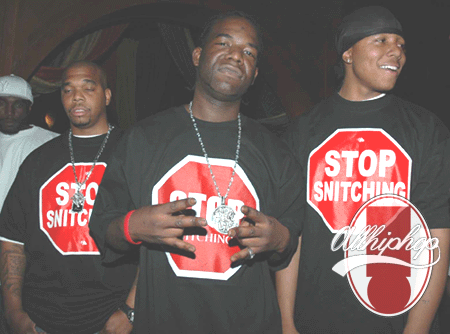
Ok, I think by now everyone is familiar with the Stop Snitching enterprise. I jumped on the Stop Snitching bandwagon last spring, with a purchase of the DVD on the internets. For months, I basked in the glory of the street motto, throwing around the hoodrat banter because it's catchy and rebellious. To revel in the popularity of Stop Snitching is to identify with the "street" - a lifestyle, mindset, and society that exists outside the bounds of white-dominated, middle-class, standard law and order civilization. Hip-hop derives its credibility from its subversive ability to mock a set of bland bourgeois values in favor of a flashy, rhythmic, and unruly culture.

However, it is a mistake to suggest that the Stop Snitching creed typifies all of hip-hop culture. This creed is undoubtedly highly pervasive in a large segment of the population that identifies with hip-hop. Yet, at some point, the line between foul, gangland violence and stylized urban garb becomes blurry. Does donning the Stop Snitching uniform imply that one embraces witness intimidation at its ugliest?

Currently, three Bloods are standing trial in Baltimore for firebombing a snitch's house. This sinful snitch happens to be the Harwood Community Association President, Edna McAbier. After years of watching thugs take over her neighborhood, McAbier began contacting the police more and more. Because she threatened the turf and thus profits of neighborhood dealers, Snitch McAbier got Molotovs launched at her crib. Does the Stop Snitching credo truly intend to silence innocent civilians on the sidelines of the drug war? Or ought it apply only to those who are part of the game?

It seems to me that some mafias respect their community fabric to the extent that no elderly lady would ever need to rat them out. However, so much gang violence in American cities has reached the point where ferocious kingpins or even minor wankstas feel menaced by geriatric neighborhood residents. Where's the justice? Stop snitching, both in video and t-shirt formats, is filled with humor and cultural nuance. However, the witness intimidation problem has become too severe to condone the whole phenom. On the one hand, I seek to extol the virtues of a rebellious subculture. On the other, I realize that too many people suffer unnecessarily when thugs tip the scales of justice in their favor.

This is not to say that I wholly empathize with urban law enforcement. I am adamantly opposed to the drug war for so many reasons. I think the so-called war on drugs is misguided, ridiculous, and inappropriate. So, perhaps law enforcement has pushed drug dealers to resort to such vile tactics. The police, in many instances, are equally a band of street thugs. I resent the tactics of both the legally-sanctioned enforcers and the illegal street soldiers. Neither side is willing to step down at this point. And, consequently, we all lose! Innocent lives are lost in the hood due to gun clapping and all manner of street antics. The civil liberties of young men are compromised across the country because law enforcement seeks to weed out the gangstas among us. Drug addicts are prevented from attaining optimal health because we have criminalized their medical problems. Law enforcement funds and other public resources are squandered on an endless battle to up the violence ante and to shower us with government propaganda.

The time has come to halt both the government gangs and the street gangs, for both are complicit in an undying war. With steady demand for hard drugs, the supply will always be available from somewhere. Regardless of how many open-air drug markets are shut down or how many drug dealers are locked up, the scourge of drug addiction will remain. The link between violent crime and psychological/medical deviance must be severed. Addiction is a medical problem, and violent crime is only necessary because dealers seek to protect their territory.

George W. Bush, come out of your rock house and tell your federal boys to start selling rock on the block. Put the dealers out of business by undercutting them - with your treatment centers dotting every major city in the country. Too many people have a vested interest in this game. Too many people have too much pride to snitch and too much idiocy to change.

I'm not sure what percentage of urban GDP is illicit drug sales. The jobs provided by this industry are indeed sought after. Profits can be enormous, but death or incarceration is virtually certain. Talented young men are lost to the drug trade when they could be excelling in other more healthy pursuits. Resources should be poured into shifting dealers into legitimate employment. In any event, jails are a short-term solution for a society that has no regard for long-term consequences. Jails provide us with tougher and tougher thugs.

Law enforcement needs to put down its big guns, too. The whole law enforcement industry (corrections, local police, DEA, FBI) has a vested interest in maintaining the current level of funding and support for the drug war. Many in this community derive profit from this sinister process. The pigs need to cooperate with the dealers and save the lives of innocent bystanders. And, the dealers cannot enforce the Stop Snitching code on those who remain outside the game, who have not agreed to abide by the street contract. Either way, drugs will eventually be taken out of the street game and pushed by medical staff in scrubs. And, I suppose, the thugs in their long white tees will ultimately find other poisons to push, once this urban pharmaceutical hustle dries up.
 
Google
Locations of visitors to this page Locations of visitors to this page Locations of visitors to this page Locations of visitors to this page